
A Controversial Confession Printed in Calvinist Geneva...an Orthodox Patriarch Meets His End on the Bosporus - Part II
How a booklet, likely printed by the Jesuits, turned theology into a death sentence; And how a 5th century Greek Bible informed Reformation-Era English Bibles

If you want to see how precarious Christian life was under Ottoman sultan rule—and how quickly Western confessional politics could destabilize the East—follow the trail of one small booklet.
In 1629, just a few years after the 5th century Bible, Codex Alexandrinus, arrives in England (see Part I), an 18-article Latin Confession of Faith booklet was published in Geneva, Switzerland, under the name of Cyril Lucaris, Ecumenical Patriarch of Constantinople. In it, the Patriarch “professed virtually all the major doctrines of Calvinism.”
Calvinism was a new Western confessional system which emerged in the sixteenth century; it was not ancient. So a document presenting an Orthodox patriarch as embracing Calvinist teaching wholesale wasn’t just controversial. It was destabilizing to the East.
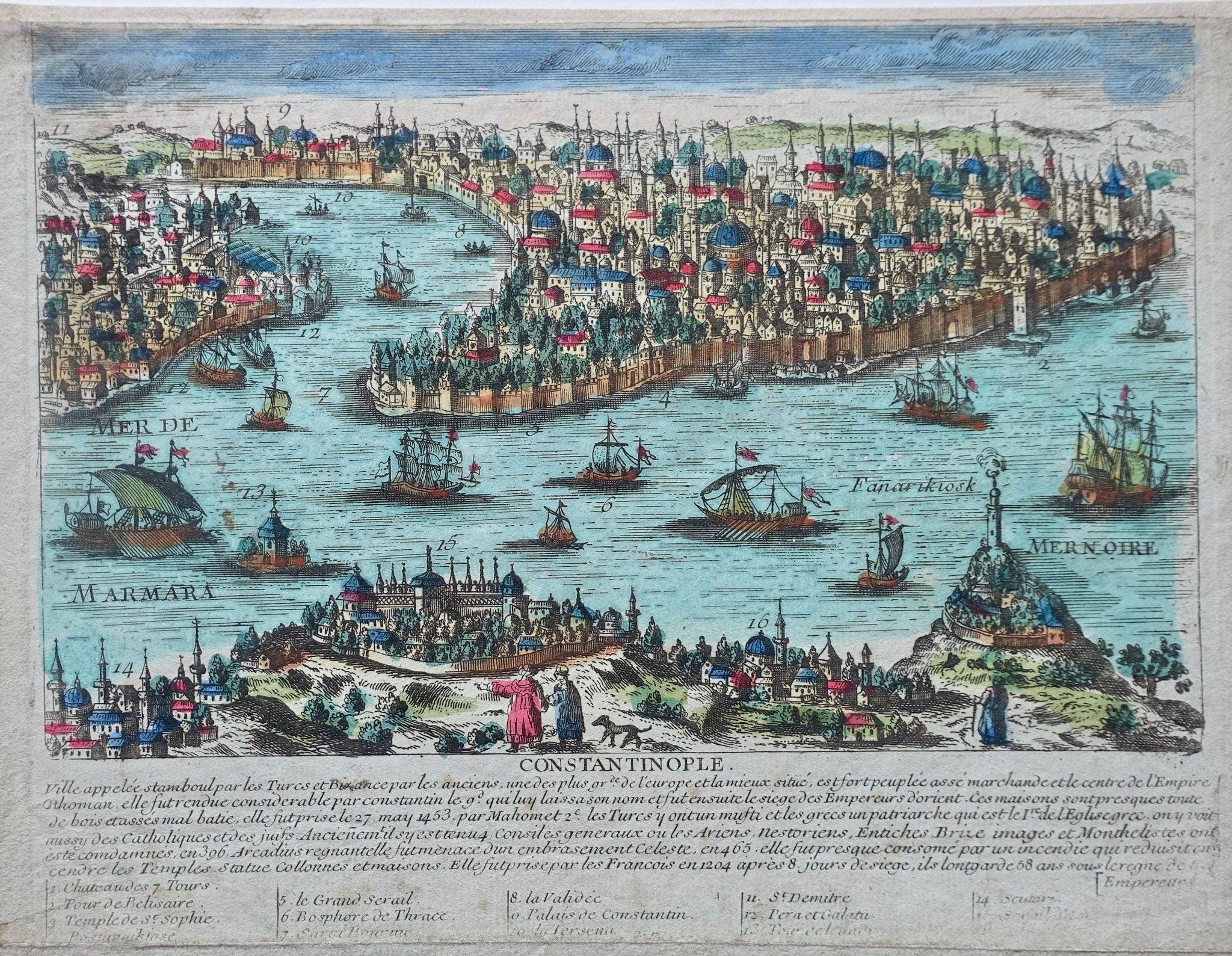
And in Constantinople, theology often spilled into the political realm. If a controversy could be framed as foreign alignment—as proof that a church leader was being claimed by outside powers or importing rival confessional agendas—it could be treated as a question of political loyalty. Under an imperial regime anxious about public order and foreign influence, that kind of framing could slide from heresy into sedition—and sedition could be punished by death.
As a separate example, Ecumenical Patriarch Parthenius III was charged with treason in AD 1657 by the Ottoman sultan because officials had intercepted correspondence seeking financial support from the Tsardom of Russia, a geopolitical rival of the Ottoman Empire at the time. Turkish officials treated it as evidence of treachery even though Russia was Orthodox just like the patriarch—a reminder that in Constantinople, a patriarch’s problem could be reclassified from church business to state security overnight. Parthenius was offered clemency if he converted to Islam; he refused and was hanged, left for three days, and then thrown into the sea. Christians retrieved his body and buried him at Kamariotissa Monastery.
Geneva Was the Fire That Burned a Patriarch
Back to Lucaris, it wasn’t only what the confession said that made it so dangerous. It was also where it originated.
A confession attributed to the Patriarch of Constantinople, printed outside the Ottoman world—especially in a Reformed printing center like Geneva, aka the home of famed Reformer John Calvin—doesn’t read like a private theological reflection. It reads like a foreign claim; this patriarch belongs to our confessional orbit and he can be used as leverage for us against you.
And once the accusation exists in print, opponents don’t need to win a theological argument. They can circulate the headline to get the result they want. Sound familiar?
The Fog: Did Patriarch Lucaris Write the Confession or Did the Jesuits Set Him Up?
The authorship dispute isn’t a footnote—it’s THE story.
Once the confession circulates, Lucaris is forced to live inside a narrative that others control because print makes an accusation portable, quotable, and repeatable. That’s because one can deny a rumor, but one can’t continually and credibly deny a pamphlet that keeps reappearing in new editions over and over again. (This is public relations 101).
In Rock and Sand, Fr. Josiah Trenham treats this episode as a genuine historical crisis with propaganda and foreign pressure in the background. He emphasizes that although Lucaris is said to have disavowed authorship orally, it was never done in writing. That single detail matters because it explains why the pamphlet could keep functioning as a weapon against him. Verbal denials vanish into thin air, but printed accusations remain, travel, and multiply. (Take note if you want to be remembered after you pass away).
Fr. Trenham’s larger point is institutional: whatever you think about Lucaris personally, the Church eventually responds officially—not with rumors, but with synodal clarity at the Synod of Jerusalem in AD 1672.
Fr. Trenham notes that historians have differed on authenticity, and there’s “a large body of books and letters” from Lucaris in which he does not advocate Calvinist positions and appears as “a defender of Holy Orthodoxy.” That said, Fr. Trenham says “there is no doubt” Jesuits worked to brand Lucaris “a Calvinist and a betrayer,” to weaken his “valiant opposition to Latin intrigues.”
But then out comes the knife: even if Lucaris disavowed it orally, Fr. Trenham emphasizes it was never done in writing. And that matters. On that evidentiary basis, Fr. Trenham leans toward the 1629 confession as genuine evidence that Lucaris likely embraced the Reformed faith. He doesn’t treat the Confession as an easy forgery; he argues the lack of proof of forgery and the lack of a written repudiation make it hard to dismiss, and he therefore leans toward it reflecting Lucaris’ real theological drift, even if he didn’t actually author the confession. Trenham notes that scholars like Kallistos Ware and Jaroslav Pelikan assume Lucaris authored it.
The Bigger Battlefield: Printing, Education, and Catechizing in the East
This is where the story stops being a theology dispute and becomes a fight over formation.
In Constantinople under the Ottomans, whoever controlled printing and education could shape what Orthodox Christians read, learned, and repeated. So when Lucaris is associated—directly or indirectly—with expanding Orthodox publishing and educational influence, it threatens entrenched interests.
Now add the Geneva confession circulating under his name and his political enemies suddenly have something printable and exportable to frame him as not merely mistaken, but aligned with and perhaps even a proxy of foreign powers.
Treason Is the Fastest Way to End a Church Fight
In the end, Patriarch Lucaris’ story is chillingly precise because it shows how quickly the rules can change under a Muslim imperial regime wary of Christian political unrest.
After an accusation that he was plotting a rebellion, Lucaris doesn’t get a theological trial. He gets reclassified.
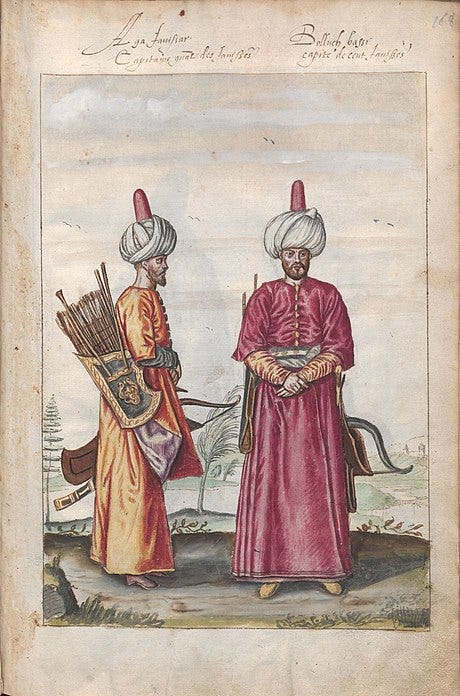
According to a major academic treatment in Past & Present, Jesuits in Constantinople accused him of planning a rebellion against the Ottomans; Lucaris was arrested, convicted of high treason, and then strangled by Janissaries aboard a ship, his body thrown into the Bosporus. Note - Janissaries were the elite infantry units that formed the Ottoman sultan's household troops. They were the first modern standing army, and perhaps the first infantry force in the world to be equipped with firearms, adopted during the reign of Murad II (r. AD 1421–1444, 1446–1451).
That detail—the ship—matters. It wasn’t merely execution; it was quiet disposal, carried out by the Sultan’s elite infantry, with the body dumped into the Bosporus Strait—which separates Europe and Asia—like contraband. Later accounts add that Christians recovered the body and buried him away from the capital, because even in death the politics around him didn’t stop.
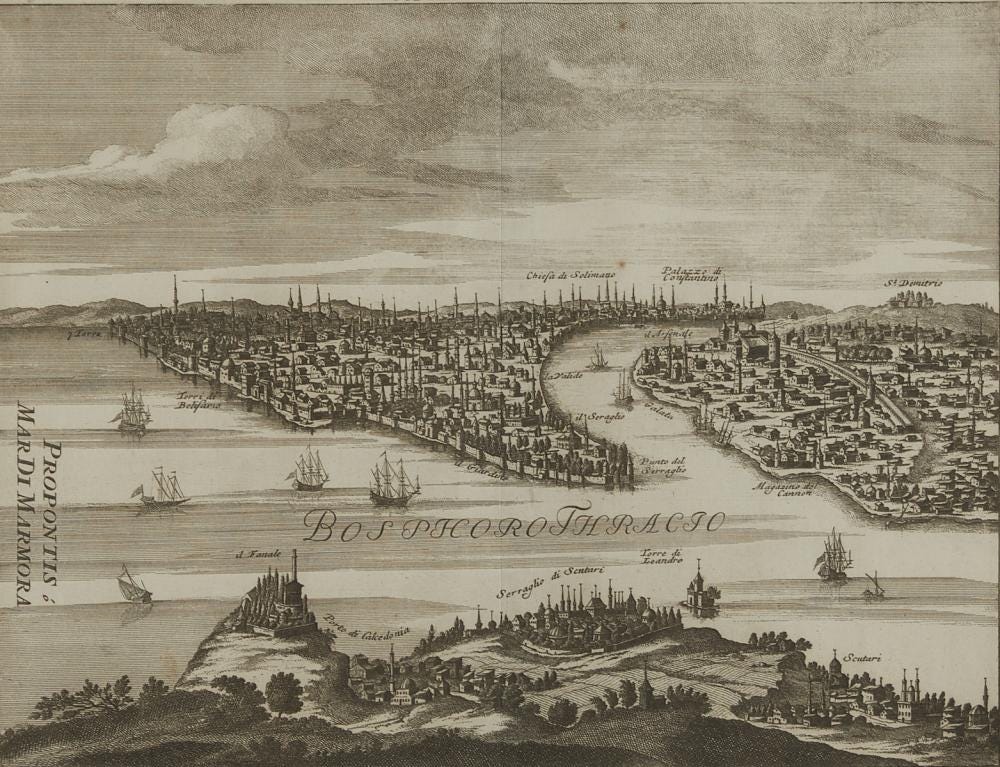
View of the Bosporus from the Topkapi Palace in Constantinople. The author and his wife visited in 2024.
That sequence is the lesson: in Constantinople, heresy was arguable, but sedition was executable. If you couldn’t defeat a church leader by legitimate ecclesial means, you defeated him through the state—by translating theology into a security threat.
Heresy can be debated. Sedition gets you killed…that said, if you’re in Calvin’s Geneva, heresy will also get you killed. Just ask Michael Servetus, who was burned alive atop a pyre of his own books for disagreeing with Calvin…but I digress.
The Orthodox Response: Jerusalem AD 1672, and the Confession of Dositheus
The Synod of Jerusalem convened in part to refute the position associated with Lucaris and it produced what’s commonly called the Confession of Dositheus—a point-by-point repudiation of Calvinist claims attributed to the Lucaris confession.
The Orthodox world needed this because it had been living inside a storm of confessional politics: embassies, pamphlets, printing projects, and rival networks all trying—explicitly or implicitly—to claim the East as a trophy for someone else’s narrative. The Lucaris controversy was the flashpoint. Whether he authored the Geneva confession or had it weaponized against him, the effect was the same: a foreign-printed text put a patriarch and his Church under a new kind of pressure.
So the Synod of Jerusalem convened with a clear agenda: not just to reject Calvinism, but to reassert what Orthodoxy is in a form that can’t be easily repackaged. It answers Reformed claims point-by-point, but it also refuses to let Reformation categories become the frame through which Orthodoxy must explain itself.
The synod’s emphases tell you exactly where the pressure points were. It leans hard into the Church’s authority and tradition against Sola Scriptura; it insists the mysteries are real and effective, not mere symbols; it speaks forcefully about the Eucharist; it rejects Sola Fide reductionism; it refuses the mature Calvinist predestination logic that swallows human freedom; and it confirms a broader canon many Protestants would not accept. In short, Orthodoxy refused to become Reformed—and refused to have its sacramental and devotional life redefined.
So the main story isn’t litigating Lucaris’ interior life like a courtroom drama. The main story is what the Church does after the smoke clears. Jerusalem in 1672 is the moment Orthodoxy stops merely denying rumors and starts issuing a public, institutional counter-text: Here is what we confess. Here is where the Reformed system doesn’t fit. And no, Geneva does not get to draft Constantinople’s creed.
So even if Lucaris privately sympathized with Reformed categories—or even if the confession was used against him in bad faith—the larger takeaway is institutional: when the crisis forced a decision, Orthodoxy answered the attempted grafting of Protestant confessional categories with a formal, comprehensive repudiation.
The Codex’s Legacy
Lastly, the Codex Alexandrinus, which Lucaris liberates from Alexandria and gifts to England, doesn’t just belong to the story of how the Bible survived—it belongs to the story of why modern Christians argue about Bible translations the way they do. When the manuscript finally landed in England in the 1620s, it wasn’t simply admired as an antique. It was used as evidence. For English and European scholars, Alexandrinus became one of the earliest, most substantial Greek control manuscripts they could consult against the printed Greek New Testaments of the day—the editions that ultimately sat behind the King James Bible.
That changed the temperature of the conversation. Instead of debating English wording in the abstract, scholars were forced to grapple with a more uncomfortable reality. The received printed text was not the only form of the Greek text, and the manuscript tradition sometimes disagreed in ways that actually affected what a translation should print.
This shift is where so many later translation fights are born. Once Alexandrinus and other early witnesses entered the room, scholars stopped treating the printed Bible as the final court of appeal and began asking harder questions: Which readings are early? Which are widespread? Which look like later clarifications that slipped into the text-stream? That shift is why modern translations sometimes add brackets or footnotes where the KJV prints a confident line—the evidence underneath is mixed, or a beloved passage appears in later copies, but not in the earliest major codices.
Two famous examples: the first being 1 John 5:7, where the KJV includes an expanded, explicitly Trinitarian line (“the Father, the Word, and the Holy Ghost…”). The issue isn’t whether the Trinity is true; it’s whether that longer wording belongs in the earliest text of 1 John. When you line up the witnesses, the expanded phrase is absent from the earliest Greek traditions—including Codex Alexandrinus—and shows up much later. This is why modern Bibles usually relegate it to a footnote rather than printing it as the main text.
The second in John 7:53–8:11 is the story of the woman caught in adultery—a passage loved for obvious reasons, preached constantly, and memorized even by people who rarely read John straight through. Yet many early witnesses don’t include it in that spot, and in some manuscript streams the story seems to float, appearing in different places. That’s why modern translations often bracket it or attach a frank note: not because the story has no spiritual weight, but because the manuscript trail forces a historian’s question—where, and when, does this enter the copied text of John?
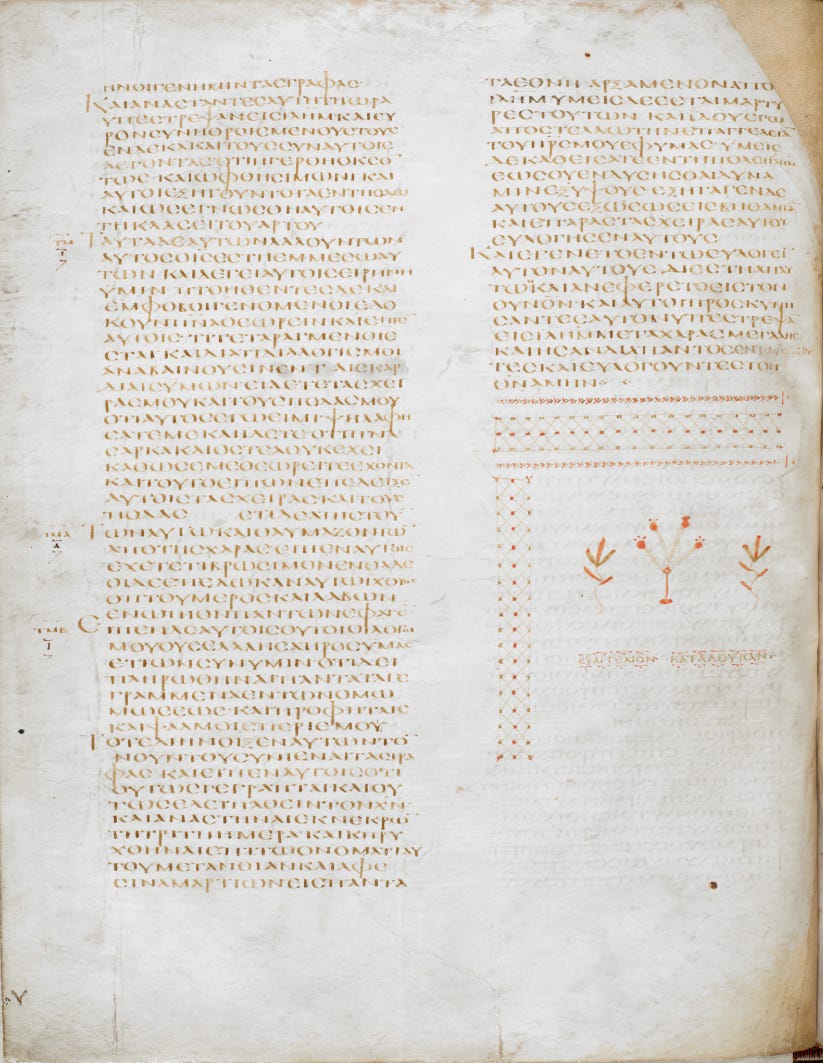
The Codex Alexandrinus, a fifth century manuscript containing the majority of the Septuagint and the New Testament, is, along with the Codex Sinaiticus, and the Codex Vaticanus, one of the earliest and most complete manuscripts of the Bible.
Manuscripts like Alexandrinus didn’t just add data. They changed the frame. You can disagree about how to handle these passages devotionally, but once the earliest codices are on the table, the method changes—and modern Bibles, with their brackets and footnotes, are simply telling you the truth about the receipts.
And that’s the irony worth underlining as we close: Lucaris sent a Bible as diplomacy, but it became a kind of providential troublemaker. Alexandrinus helped the West recover a more historically grounded view of Scripture’s transmission—one that doesn’t fear variants, but weighs them; one that doesn’t pretend the printed page fell from heaven, but asks how the Church actually received, copied, and preserved the text. In other words, a political gift ended up disciplining Western certainty. Not by undermining Scripture, but by pushing readers and translators to handle it with more honesty—less swagger, more evidence, and a clearer sense that the Bible has a history.
____________________________________________________________________________
Does your version of the Bible contain the Gospel of John and I John that reflect the earliest forms of Holy Scripture?
The ESV that I usually refer to for New Testament readings: 1 John 5:7 & 8 reads "for there are three that testify. 8 - the Sprit and the water and the blood; and these three agree."
In John 7:53 - 8:11 has a footnote at the end of 7 (which ends with verse 52) stating "the earliest manuscripts do not include 7:53 - 8:11.
1 John isn't the only one....the Gospel of Mark also appears to have had later scribes expand a few sections compared with the earliest manuscripts.
Mark 16:9–20: this is the famous added ending with post-resurrection appearances, the “signs” (including handling snakes / drinking poison), and the ascension. Most scholars think Mark originally ended at 16:8 (“…for they were afraid”), and that 16:9–20 was attached later to supply a more finished ending.